
Summit at Knoxville is located in Seymour, Tennessee, providing mental health and addiction treatment for North Carolina residents. For people in Asheville and across the western North Carolina mountains, our campus sits about two hours west on Interstate 40, close enough to reach in an afternoon and far enough to step out of what has become unmanageable.
Clinically reviewed by the Summit at Knoxville clinical team · July 2026

If you are searching for drug rehab in North Carolina at an hour when the house is finally quiet, you are probably not looking for yourself alone. You may be a parent in Asheville, a partner in Waynesville, or an adult child in Hendersonville, trying to find a bed for someone whose drinking or drug use has stopped responding to every promise they have made. The mountains that make western North Carolina beautiful also make specialized care hard to reach, and the nearest right fit is sometimes across a state line.
For many western North Carolina families, that line runs along Interstate 40 into East Tennessee. Summit at Knoxville sits just south of Knoxville in Seymour, and it is one of the closest residential substance use programs for a wide stretch of the mountains. Our areas we serve map is drawn around who can actually make the drive, and the western edge of North Carolina falls comfortably inside it.
Who Travels to Us From Western North Carolina
The people who reach out first from North Carolina are often worn down by logistics as much as by the illness itself. They have called programs in Asheville and been put on a waitlist. They have looked east toward Charlotte or the Triangle, three to five hours away, and realized that distance would keep the family from visiting on a Sunday. Somewhere in that search, the map starts pointing west instead.
Western North Carolina is mountain country, and mountain country has always had thinner access to specialized behavioral health care. Rural and Appalachian communities across the region have faced well-documented gaps in reaching substance use and mental health treatment, a pattern tracked by the Appalachian Regional Commission. For a family in Buncombe, Haywood, Madison, or Jackson County, the honest reality is that the right level of care may be a drive rather than a local option.
Most people who come to us from North Carolina live within about two hours of campus: Asheville, Waynesville, Sylva, Cherokee, and the smaller towns strung along the I-40 corridor and US-19. Some fly into Asheville Regional Airport (AVL) and are met on the Tennessee side. For state-run programs and crisis lines back home, the North Carolina Department of Health and Human Services and NAMI North Carolina are good starting points, and families often lean on those alongside a residential stay here.
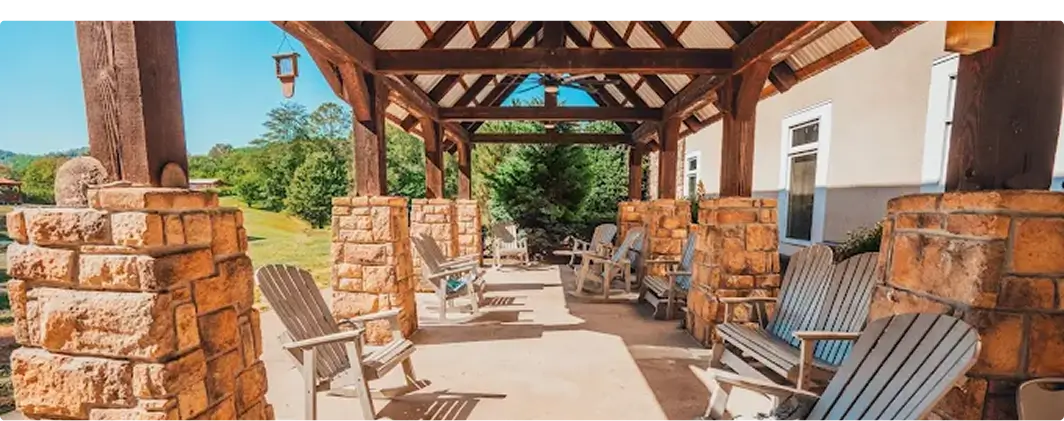
The Drive: I-40 From Asheville to Our Knoxville-Area Campus
Leaving home to get well can feel backward, especially when home is as beautiful as the Blue Ridge. But putting a couple of hours between a person and the places tied to their use is often part of what makes early recovery hold. The road is not just an obstacle to get past; for a lot of people it is the first quiet stretch they have had in months.
From Asheville, the route is a straight shot west on Interstate 40. The road climbs through the Pigeon River Gorge and crosses into Tennessee at the northern edge of the Great Smoky Mountains, the national park that straddles the state line with Cherokee and the North Carolina park entrances on one side and the Tennessee foothills on the other. On an ordinary day it is a little over 100 miles and about two hours.
Once you cross to the Tennessee side, you are in the same Smoky Mountains gateway that runs through the towns we serve near Sevierville and Pigeon Forge along the US-441 corridor, then north toward Seymour and Knoxville. Knoxville’s airport, TYS, is about 30 minutes from campus for anyone coordinating travel for a family member. For most North Carolina families, though, it is simply a drive they can make in an afternoon and repeat when it is time for a family session.

Residential Drug Rehab and Detox at Summit at Knoxville
When someone arrives from North Carolina, the first job is usually physical safety. If the body has grown dependent on alcohol, opioids, or benzodiazepines (the sedatives often prescribed for anxiety or sleep), stopping all at once can be dangerous, and the first days need medical eyes. Our medically supervised detox is where that begins, with clinical monitoring through the stretch when withdrawal is at its most intense.
Detox settles the body; it does not, on its own, change what sent someone back to using. That work happens in residential treatment, where the days are structured and predictable. Structure is a large part of how this program works. A steady rhythm of therapy, meals, rest, and group time gives a nervous system that has been running on fear something reliable to lean on.
Care here draws on approaches with real research behind them, and the right mix is matched to the person, in line with the placement criteria the American Society of Addiction Medicine uses to decide the level of care. Common pieces include:
- Cognitive Behavioral Therapy (CBT): a practical, skills-based therapy for catching the thoughts that lead to a drink or a dose and changing what happens next.
- Dialectical Behavior Therapy (DBT): a structured approach that teaches ways to ride out intense feelings and cravings without acting on them.
- Psychiatric medication management: ongoing review of medications by our medical team, so a mood or anxiety condition is treated at the same time as the substance use.
- Group therapy and psychoeducation: learning how substances and stress affect the brain and body, in a room with other people who understand the fight.
- Nutritional counseling: rebuilding the basics of eating and sleep that long stretches of use tend to wreck.
When Substance Use and Mental Health Overlap
For a lot of the people who come to us, the drinking or the drug use grew up alongside something else: a depression that never lifted, bipolar disorder, the long shadow of trauma, or a psychotic illness that made the world feel unsafe. Treating one problem and ignoring the other is how people end up back in the same emergency a season later.
Summit at Knoxville is built around exactly that overlap. The program specializes in serious mental illness that occurs together with substance use, what clinicians call co-occurring disorders, meaning two conditions that feed each other and have to be treated at the same time. For someone whose primary struggle is the mental illness itself, our residential mental health track carries the same structure and medical oversight.
That makes the center a strong fit for adults dealing with severe or treatment-resistant depression, bipolar disorder, severe PTSD and complex trauma, or schizophrenia alongside substance use. It also makes it a poor fit for someone who only needs a few outpatient sessions close to home. Being clear about that is part of how our admissions team helps a North Carolina family decide whether the drive west actually makes sense.

Starting Care From North Carolina
If you have read this far, you are already doing the hard part, which is refusing to let another month go by. Whether the person who needs care is you or someone you have been holding up for a long time, the next step is small: find out what a stay here would actually cost and cover. You can start with our insurance verification, and the admissions team can talk you through what an admission looks like, how the drive from western North Carolina usually works, and whether Summit at Knoxville is the right level of care. If you are not ready to make that call today, that is okay; you can come back to it when the time is right. When you are ready, we are here.
Verify InsuranceFAQs About Addiction Treatment for North Carolina Residents
No. Summit at Knoxville is a Tennessee treatment center, just south of Knoxville in Seymour. It is licensed in Tennessee and does not operate a North Carolina facility. Western North Carolina residents travel to the Knoxville-area campus for care, most often a drive of about two hours west on Interstate 40 from the Asheville area. We offer drug rehab, detox, mental health and addiction treatment for North Carolina Residents.
The campus is a little over 100 miles west of Asheville, or roughly two hours on Interstate 40 through the Pigeon River Gorge and across the Tennessee state line. Asheville Regional Airport (AVL) is an option for anyone coordinating travel, and Knoxville’s TYS airport is about 30 minutes from campus.
Yes. Care usually begins with medically supervised detox for people whose bodies have become dependent on alcohol, opioids, or benzodiazepines, then continues in residential substance use treatment. Because the program specializes in co-occurring mental illness, a person’s depression, bipolar disorder, trauma, or other condition is treated alongside the substance use.
Often, yes. Many health plans include out-of-state and in-network options for residential care, but the details depend on your specific policy. The simplest way to find out is to submit your information through the insurance verification page, and the admissions team can review what your plan covers before you make any decisions.
Sources
- Substance Abuse and Mental Health Services Administration. (n.d.). FindTreatment.gov. Retrieved from: https://findtreatment.gov/. Accessed on July 13, 2026.
- American Society of Addiction Medicine. (n.d.). The ASAM criteria. Retrieved from: https://www.asam.org/asam-criteria. Accessed on July 13, 2026.
- North Carolina Department of Health and Human Services. (n.d.). NC DHHS. Retrieved from: https://www.ncdhhs.gov/. Accessed on July 13, 2026.
- NAMI North Carolina. (n.d.). NAMI North Carolina. Retrieved from: https://naminc.org/. Accessed on July 13, 2026.
- Appalachian Regional Commission. (2019). Health disparities related to opioid misuse in Appalachia. Retrieved from: https://www.arc.gov/wp-content/uploads/2020/06/HealthDisparitiesRelatedtoOpioidMisuseinAppalachiaApr2019.pdf. Accessed on July 13, 2026.